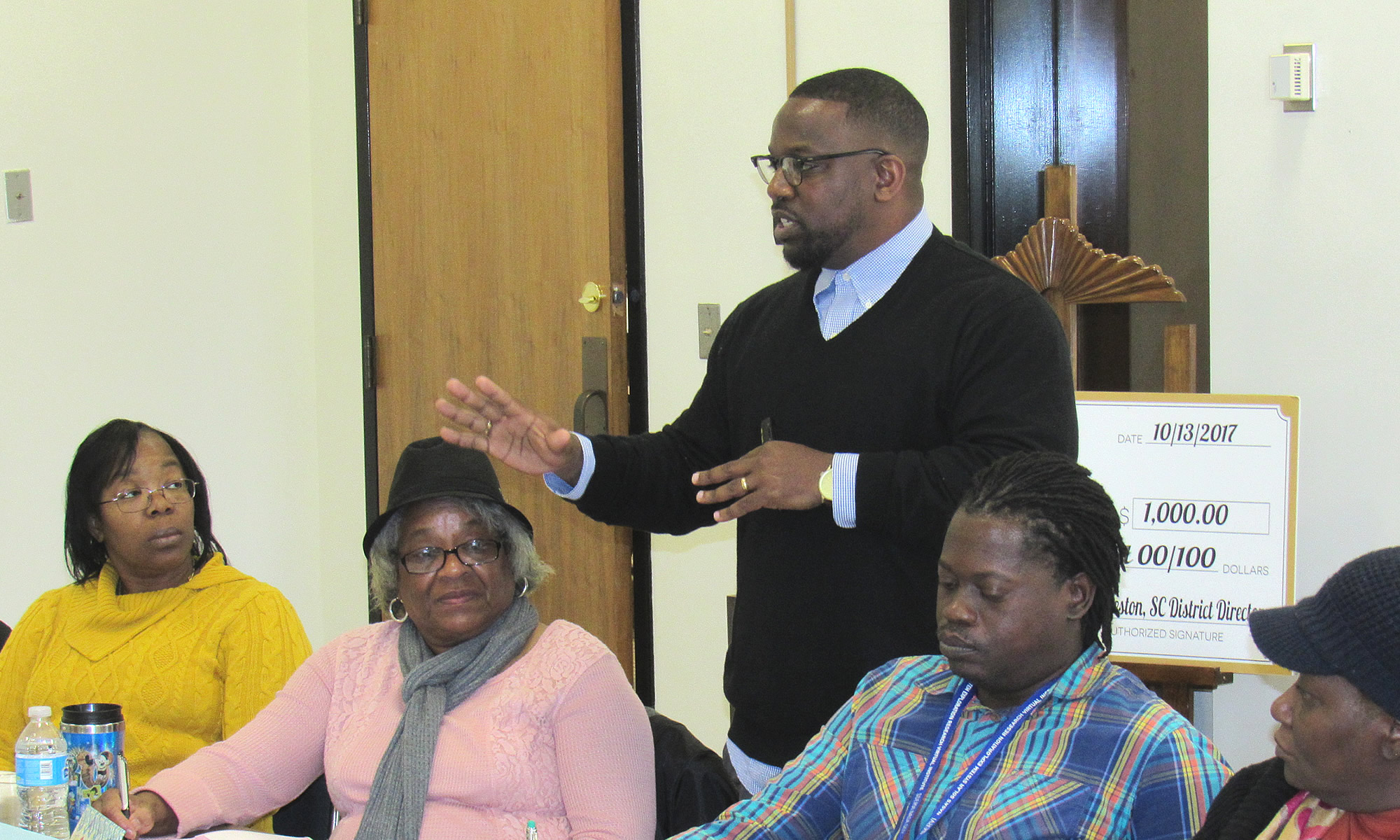
"Successful and enduring movements for change require those in positions of power to share power and welcome new ideas, and we have miles to go in that regard."

-- The Rev. Joseph A. Darby

The Rev. Joseph A. Darby
South Carolina civil rights and religious leader
January 2006

Overview: In this January interview with the Center for a Better South, civil rights leader Joseph A. Darby, pastor of Morris Brown AME Church in Charleston, S.C., talks about how progressives should push policies that improve education and expand economic opportunities for Southerners in an overall effort to boost everyone's quality of life.

QUESTION ONE: What's the greatest challenge faced by Southerners who want the region to become more progressive?

THE REV. JOSEPH. A. DARBY: The greatest challenge is probably communication and cooperation among Southerners who want the region to become more progressive. While most Southerners would say that they want progress, "progressive" is the current label placed on a diverse group of Southerners who have broad areas of agreement. Most "progressives" of my acquaintance agree that there is a need for quality public education, economic equity opportunity and equal rights in the South, consider public policies that assure the well-being of all citizens to be a legitimate function of government, and see a need to acknowledge and correct chronic barriers to equity.

Challenges, however, arise when it comes to how progress should look. I've had interesting debates with those who champion environmental issues when their positions run counter to projects that would bring opportunity to communities that are poor and black, and with those in the gay and lesbian community who appreciate my advocacy for basic legal rights but are bothered that as a pastor, I can't embrace same-sex marriage.

ABOUT JOE DARBY

The Rev. Joseph A. Darby, pastor of historic Morris Brown AME Church in Charleston, S.C., is a dynamic leader in the faith and civil rights communities in the South.

A native of Columbia, S.C., he has a bachelor's degree from the University of South Carolina and prepared for the ministry by attending the Lutheran Theological Southern Seminary. A fourth-generation minister in the African Methodist Episcopal Church, his congregation is the largest in the Seventh Episcopal District of the AME Church.

Darby, winner of numerous civic and professional awards, also is former first vice president of the S.C. Conference of Branches of the NAACP. A recognized authority on historically black churches, Darby lives in Charleston with his wife Mary. They have two sons.

I've also had the unpleasant experience of being called upon by friends to support their "progressive" issues but sometimes finding those friends to be reluctant when support was needed for African-American community issues, and of seeing "progressive" political candidates become decidedly "conservative" in the quest for Southern votes.

If those who embrace Southern progress are to achieve that goal, then we must learn how to communicate with each other in an air of mutual respect, celebrating our points of agreement while affirming our right to disagree at times and agreeing on strategies to push the broader progressive agenda forward. We can then clearly articulate an agenda for progress instead of just responding to conservative ideas, and can then take on the greater challenges to communication posed by those who are far from progressive and who make political hay of division.

QUESTION TWO: In your previous answer, you say progressives have to do more than just respond to conservative ideas. What are some platforms that progressives in the South can start pushing that will unite them and reap rewards at the polls? In other words, what issues should frame a successful progressive agenda that will put more progressive people in office?

DARBY: We need a progressive platform on education that:

(1) affirms the worth of public schools;

(2) assures equitable funding for all public schools;

(3) acknowledges past inequities;

(4) sets forth steps in money, facility improvement and teacher recruitment to correct those past inequities. We could then address the current calls for "choice" without public funding for private schools, because parents would then have a true choice between quality public and private schools.

We also need a progressive platform for economic development that encourages responsible businesses to come south - and not just because the wages are low and the natives are "quaint." That platform should also provide incentives for businesses to:

(1) nurture and contract with minority businesses;

(2) work with government and the public education system to prepare local talent for upper echelon jobs; and

(3) locate in areas that face the greatest economic need.

The education and economic platforms go hand in hand and lead to something that's harder to address in public policy -- quality of life.

A truly progressive platform should also speak to how good schools and good jobs strengthen and create safer communities, spur quality housing, promote stable families, and foster individual independence and responsibility. Those aren't conservative values, they're American values.

QUESTION THREE: Jim Wallis, the major evangelical progressive leader, says what's needed is a social movement to make progressive things happen in the current narrow political environment. Do you agree and, if so, what can spawn such a movement?

DARBY:
I strongly agree with Wallis. Any successful progressive social movement has to acknowledge religious faith as more than a simplistic "Christian left" response to the "Christian right" (which is often neither Christian nor right). Progressives must realize that their numbers include people of faith who view civic responsibility as a moral imperative. The modern civil rights movement was led and supported in large measure by people of faith. The basic political strategies used by the "Christian right" were born in historically black churches. "Faith-based" government funding for and candidate visits to churches in election years show that religion matters.

I'd again say that education and economic development are key progressive platform issues -- both of which can be viewed through the eyes of faith - for good religion doesn't just ask who sleeps together.

Good religion raises greater questions of justice and decency for all of Creation. If progressives can include those who frame such issues in the language of faith and let them help to shape the platform (rather than just telling them to get out the vote every two years), then we'd have the makings of a social movement that could change and broaden the current narrow political environment.

That also, however, requires tolerance by progressives who choose not to embrace any religion. It also, quite frankly, means helping some of my progressive clergy colleagues to understand that "advocacy" is not a dirty word, and that people of faith can't really "help the needy" without asking political leaders why people are needy in America of 2006.

QUESTION FOUR: Intellectually, it doesn't seem like rocket science that progressives need to build this movement that incorporates things like education, good economic development, a respect for the outdoors and faith. But practically with people glued to their televisions and plastered to their couches, how can it be built? In other words, what has to happen beyond rhetoric to really grow such a movement and make it happen?

DARBY: That's a harder question. Fifty years ago, the brutal and stark events of the day created a sense of urgency that energized a diverse group of people to take action, and the modern civil rights movement got rolling. When the passage of laws, however, convinced many of them that black folk had "overcome," people started looking to their own interests. I think that's where we are today. A lot of progressives feel a sense of urgency about their individual or group issues, but that hasn't translated into a broader and more aggressive movement. We've gotten comfortable and lost our shared focus on progress, our willingness to sacrifice for others and our sense of urgency, and haven't done a good job of energizing new generations.

My hope is that the events of the day will produce a sense of shared urgency that will spur progressive action, hopefully without the kind of demagoguery that fueled the "conservative revolution" or without a tragedy that so outrages the populace that it becomes a focal point for action. My suggested strategy goes back to question one. People of like minds need to sit together consistently, talk to each other without issues of ego or control, and formulate ways and means of addressing the problems of the day in a way that makes people want to get on board and take action. We also need to bring young people and new faces to the table to help shape the message and movement. Successful and enduring movements for change require those in positions of power to share power and welcome new ideas, and we have miles to go in that regard.

QUESTION FIVE: What role does the black church have in powering progressive ideas?

DARBY: The historically black church and clergy - and people of faith in general - still have a role to play as one of the organizations invited to the progressive table. That presence should come with the understanding that:

(1) not all African-American Christians are "progressives";

(2) some newer evangelical African-American churches have only a limited commitment to advocacy and action to change public policy; and that

(3) all faith groups have to exercise care not to be partisan in the way that they register, educate and mobilize voters and in how they take policy stands.

I think that people of faith serve as the "conscience" of progressive movements - making sure that they embrace the well being of all players, making sure that the message resonates with people of faith, and translating the message of progress into the language of faith. African-American Christians tend to be progressive on issues of equity and progress, but conservative on issues of the "flesh."

Our presence enables progressives to take principled stands that may not please all at the table, but that will result from the kind of dialogue that leads to common ground. That presence is critical, since many black churches only hear from those in the political arena in election years, and end up feeling "used." That presence will also require some progressives to face their personal prejudices and misconceptions, and welcome people of faith and people of color as equal partners - not just as "troops" to be mobilized when the agenda is formed.

* * *

If you'd like to receive Better South news updates by email, please send us an email today.

ABOUT THE FIVE QUESTIONS SERIES

In the Center for a Better South's Five Questions project, staff members to pose challenging questions to Southern leaders for their views on how to deal with public policy issues.

Republication encouraged. Media organizations are encouraged to reprint the Five Questions interview on editorial pages to stimulate conversation and provide people living in the South with a new way of looking at things. No reprint permission is needed, but the Center would appreciate informal e-mail notification of any reprints. Please contact us at: info@bettersouth.org for any questions or comments.

© 2005, Center for a Better South.


The Center for a Better South's Five Questions project is an online interview series in which Center staff pose challenging questions to Southern leaders for their views on how to deal with public policy issues.

Please contact us at: info@bettersouth.org for any questions or comments.


Alan Essig, 10/.05

Roy E. Barnes, 9/05

William F. Winter, 8/05

Join: You can join the Center's e-mail list to keep up-to-date.

Money: You can help the Center's staff to raise money to offset startup costs.


Center for a Better South
P.O. Box 22261
Charleston, S.C. 29413